
Mold in Closets in Indian River: What Merritt Island Property Owners Should Know
Closets are one of the most common — and most overlooked — places where mold develops in Indian River homes. Because closets are closed off, lightly used, and often tucked against exterior walls, they create the perfect environment for trapped moisture. In a coastal area like Merritt Island, where humidity is part of daily life, that trapped moisture can quickly turn into a mold problem.
For property owners near the Indian River, closet mold is rarely random. It is usually a sign that humidity, airflow, or building moisture is not being managed effectively. Understanding why closets are so vulnerable helps homeowners, landlords, and property managers catch problems early and prevent mold from spreading into larger areas of the home.
Why Closets Are High-Risk Areas Near the Indian River
Homes near the Indian River are exposed to constant moisture pressure. Humid outdoor air, salt air exposure, and frequent rain all contribute to higher indoor humidity levels, even when air conditioning is running.
Closets often have little to no ventilation. When doors stay closed, air circulation drops and moisture becomes trapped. If the closet is located along an exterior wall, that wall may stay cooler than interior walls, increasing condensation risk.
In Indian River homes, these conditions combine to make closets one of the easiest places for mold to develop quietly.
How Closet Mold Usually Starts
Closet mold typically begins long before it is visible. Moist air enters the space and settles on drywall, wood framing, or stored items. Without airflow, that moisture has nowhere to go.
Over time, materials absorb humidity from the air. Drywall and wood are especially vulnerable. Once moisture content stays elevated long enough, mold can begin growing behind walls, on surfaces, or inside the closet structure itself.
Because closets are not inspected often, growth can continue unnoticed for months.
Common Closet Mold Locations in Indian River Homes
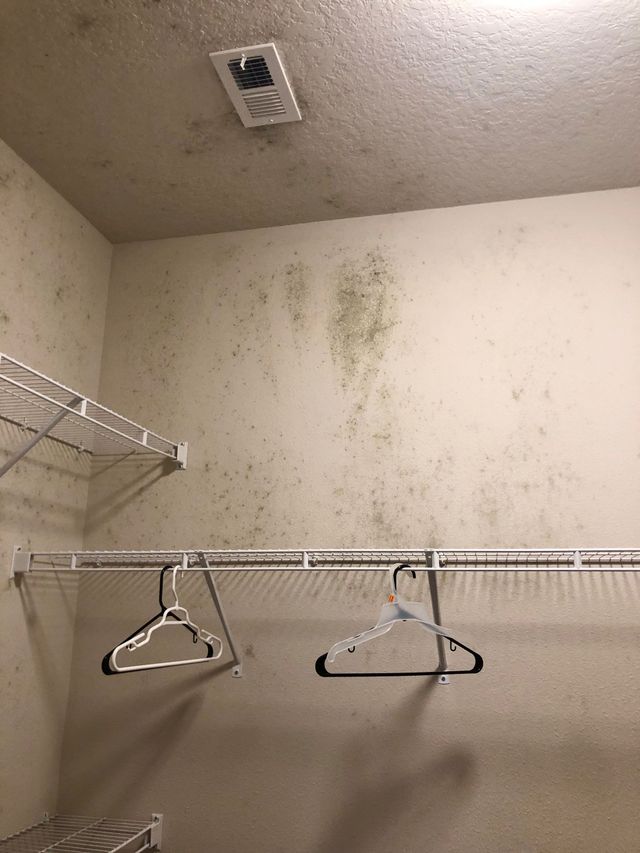
Mold inside closets often appears first in predictable areas. Back walls, especially those facing the exterior, are common trouble spots. Lower wall sections near baseboards are also vulnerable due to slab moisture migration.
Corners of closets, where airflow is weakest, frequently show early growth. Ceilings inside closets may develop mold if attic humidity is high or if warm air rises and condenses above the space.
In some cases, mold is found on clothing, shoes, or cardboard boxes before it is seen on the walls themselves.
Why Closet Mold Is Worse in Slab Foundation Homes
Most homes near the Indian River are built on slab foundations. Concrete slabs naturally transmit moisture, especially when the water table is high.
Ground moisture can migrate upward through the slab and collect in lower wall sections. Closets, which often have limited airflow and insulation, are especially affected by this moisture.
This is why mold in Indian River closets is frequently found near the floor or behind baseboards.
The Role of Humidity and Air Conditioning
Air conditioning helps manage indoor humidity, but it does not always protect closets. If a home’s HVAC system is oversized, it may cool rooms quickly without removing enough moisture.
Closets often have no supply vents or return airflow. Even when the rest of the home feels comfortable, humidity can remain elevated inside closed closets.
In Indian River homes, this imbalance is a major contributor to recurring closet mold.
Why Closet Mold Often Goes Unnoticed
Closets are not living spaces, so subtle signs are easy to miss. Musty odors may be faint and dismissed as coming from clothing. Discoloration on walls can be hidden behind hanging items or shelving.
By the time mold becomes obvious, growth may already be established behind drywall or inside wall cavities. At that point, cleaning the visible area alone rarely solves the problem.
Regular inspection is the only reliable way to catch closet mold early.
Mold on Clothing and Stored Items
One of the most frustrating aspects of closet mold is damage to personal belongings. Clothing, shoes, bags, and cardboard boxes absorb moisture easily.
In humid Indian River homes, stored items can develop mold even when walls appear clean. This often leads property owners to focus on cleaning belongings rather than addressing the moisture conditions causing the problem.
If mold appears on stored items, it is a strong indication that humidity inside the closet is too high.
Why DIY Cleaning Rarely Fixes Closet Mold
Wiping down closet walls or cleaning affected items may temporarily improve appearance or odor, but it does not address moisture trapped behind surfaces.
In many cases, moisture remains inside drywall, insulation, or framing. Mold regrows once humidity rises again, especially during summer months.
DIY cleaning also risks spreading spores into other parts of the home if containment is not used.
Hidden Mold Behind Closet Walls
Closet mold is often just the visible portion of a larger issue. Growth behind drywall is common, especially when exterior walls or plumbing lines are involved.
Water intrusion from storms, condensation inside walls, or minor plumbing leaks can keep wall cavities damp without visible signs. Closets, with limited airflow, become the first place where mold becomes noticeable.
This is why professional evaluation often reveals more extensive moisture issues than expected.
How Professional Inspections Identify Closet Mold Causes
Professional mold inspections focus on moisture patterns rather than surface appearance alone. Inspectors evaluate wall moisture, slab conditions, attic influence, and airflow.
Moisture meters help identify damp drywall behind closet walls. Attic inspections may reveal humidity or insulation issues contributing to condensation above closets.
In Indian River homes, inspections often show that closet mold is linked to a combination of humidity control gaps and building design.
Mold Removal Merritt Island works with local property owners to evaluate closet mold using methods tailored to coastal conditions and slab construction common in Merritt Island.
Proper Mold Remediation for Closets
Effective remediation depends on how far mold has progressed. Surface mold may require detailed cleaning and moisture correction. Hidden mold often requires removing affected drywall or insulation to access and dry materials properly.
Containment is important to prevent spores from spreading into bedrooms or living areas. Once remediation is complete, underlying moisture issues must be corrected to prevent recurrence.
Without addressing airflow and humidity, mold in closets almost always returns.
Preventing Mold in Indian River Closets
Prevention focuses on airflow and moisture control. Keeping closet doors open periodically improves circulation. Avoid packing closets tightly, especially against exterior walls.
Using moisture-absorbing products may help temporarily, but long-term prevention depends on proper HVAC performance and indoor humidity control.
Inspect closets regularly, especially after storms or during humid months. Pay close attention to back walls, corners, and lower wall sections.
Why Local Experience Matters
Closet mold near the Indian River behaves differently than it does inland. Coastal humidity, slab foundations, and building layouts unique to Merritt Island influence where and how mold develops.
Local experience means understanding these patterns and knowing where to look beyond the obvious. This leads to faster identification of root causes and more effective long-term solutions.
A Practical Approach for Property Owners
Mold in closets is not just a cosmetic issue. It is often an early warning sign that moisture control needs attention.
By inspecting closets regularly, managing humidity, and addressing issues promptly, property owners can prevent small problems from turning into larger remediation projects. Early action protects both the structure and personal belongings.
When closet mold persists or returns, professional evaluation provides clarity. Mold Removal Merritt Island is familiar with the specific moisture challenges affecting closets in Indian River homes and throughout Merritt Island, offering guidance grounded in real local conditions..
